Attackers Don’t Break In.
They Log In.  

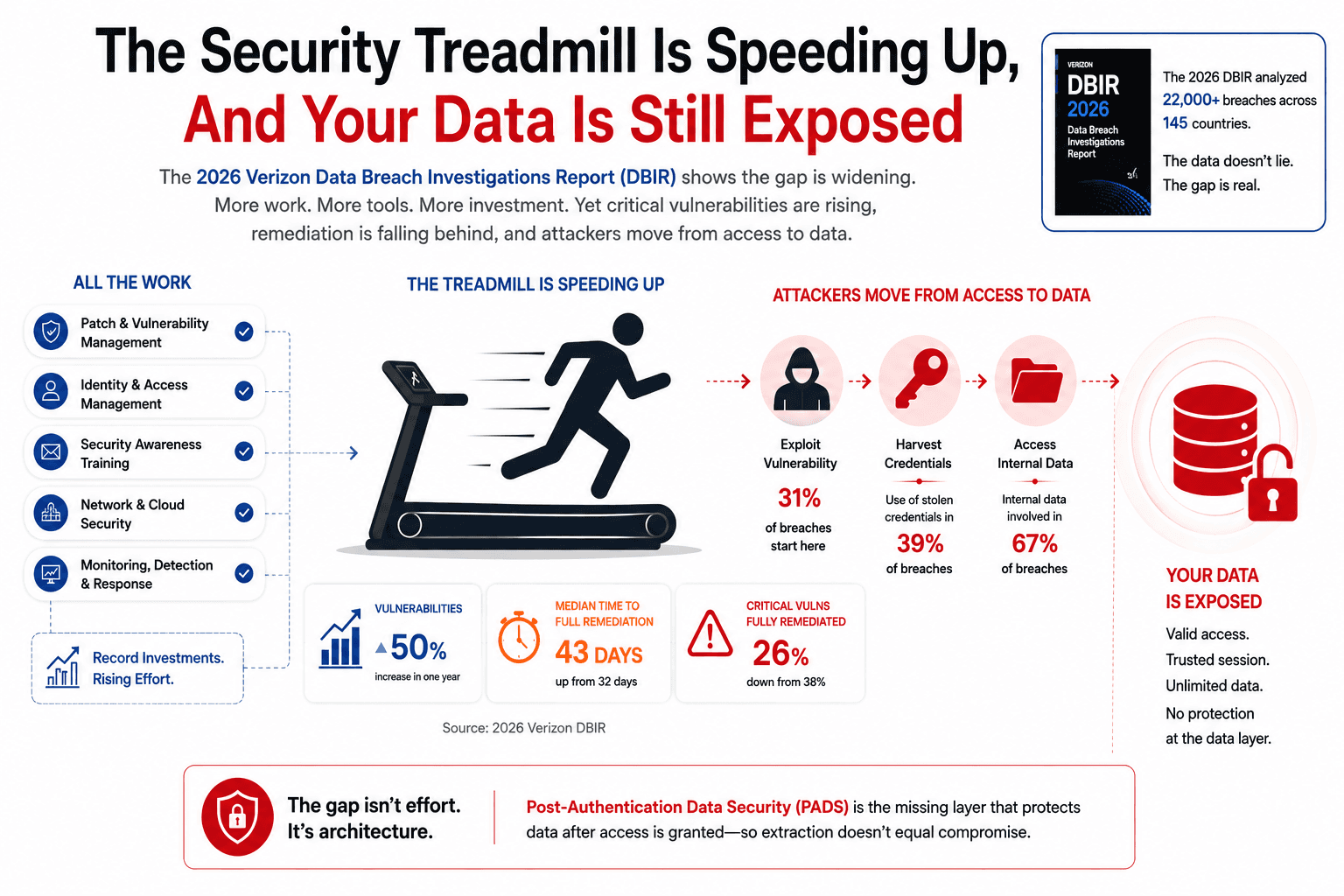
Over 74% of breaches involve post authentication access

Over 74% of breaches involve post authentication access

Over 74% of breaches involve post authentication access

Post-Authentication Data Security (PADS) by FenixPyre

The Pattern Is Familiar

The Pattern Is Familiar

Network Evolution

Perimeter → Zero Trust

Perimeter → Zero Trust

Threat Evolution

AV → EDR

AV → EDR

Data Evolution

DLP → PADS

DLP → PADS

What makes PADS Unavoidable today

What makes PADS Unavoidable today

Traditional security protects the "room," but the "jewelry" is being carried out the front door by people with keys.
FenixPyre doesn’t replace the door, we ensure the valuables stay protected even after it’s opened.

Identity is Proven to Fail

Phishing, MFA fatigue, and token replay make credential compromise a matter of when, not if. Access is no longer a proxy for trust.

Data Outpaces Controls

Files move across SaaS, clouds, and unmanaged devices. Once access is granted, data slips beyond environment-based controls and becomes implicitly trusted.

Objective: Monetization

Attackers want data that is easy to access and monetize. They want readable, portable files they can exfiltrate, ransom and sell. Security must follow the objective.

Identity is Proven to Fail

Phishing, MFA fatigue, and token replay make credential compromise a matter of when, not if. Access is no longer a proxy for trust.

Data Outpaces Controls

Files move across SaaS, clouds, and unmanaged devices. Once access is granted, data slips beyond environment-based controls and becomes implicitly trusted.

Objective: Monetization

Attackers want data that is easy to access and monetize. They want readable, portable files they can exfiltrate, ransom and sell. Security must follow the objective.

78% Increase

THE VOLUME GAP

U.S. data compromises jumped 78% in a single year (2023), hitting an all-time high despite record security investments.

82%

THE HUMAN ELEMENT

Of breaches involve stolen credentials, phishing, or simple human error.

$4.88M

AVERAGE BREACH COST

The 2024 global average cost of a data breach, a record high for the industry.

78% Increase

THE VOLUME GAP

U.S. data compromises jumped 78% in a single year (2023), hitting an all-time high despite record security investments.

82%

THE HUMAN ELEMENT

Of breaches involve stolen credentials, phishing, or simple human error.

$4.88M

AVERAGE BREACH COST

The 2024 global average cost of a data breach, a record high for the industry.

78% Increase

THE VOLUME GAP

U.S. data compromises jumped 78% in a single year (2023), hitting an all-time high despite record security investments.

82%

THE HUMAN ELEMENT

Of breaches involve stolen credentials, phishing, or simple human error.

$4.88M

AVERAGE BREACH COST

The 2024 global average cost of a data breach, a record high for the industry.

INCIDENT ANALYSIS LOG

INCIDENT ANALYSIS LOG

VULNERABILITY: IMPLICIT TRUST IN AUTHENTICATED SESSIONS

VULNERABILITY: IMPLICIT TRUST IN AUTHENTICATED SESSIONS

VULNERABILITY: IMPLICIT TRUST IN AUTHENTICATED SESSIONS

DEFENSE OUTCOME
DEFENSE OUTCOME

FenixPyre Neutralization: 100%

FenixPyre Neutralization: 100%

FenixPyre Neutralization: 100%

TARGET ORGANIZATION
TARGET ORGANIZATION
TARGET ORGANIZATION
BREACH METHOD
BREACH METHOD
BREACH METHOD
WHAT FAILED
WHAT FAILED
WHAT FAILED
THE PADS DIFFERENCE
THE PADS DIFFERENCE
THE PADS DIFFERENCE

Snowflake

Credential Stuffing

Snowflake

Credential Stuffing

Snowflake

Credential Stuffing
Stolen Creds
Stolen Creds
Stolen Creds
Authentication succeeded
No malware
No malware
No malware
No exploit
No exploit
No exploit
Activity looked “normal”
Encryption at rest worked
Data decrypted on access
Exported datasets remain encrypted.
Stolen data is unreadable outside approved policy.
Credential compromise ≠ data loss.
Exported datasets remain encrypted.
Stolen data is unreadable outside approved policy.
Credential compromise ≠ data loss.
Exported datasets remain encrypted.
Stolen data is unreadable outside approved policy.
Credential compromise ≠ data loss.

MGM Resorts

Social Engineering

MGM Resorts

Social Engineering

MGM Resorts

Social Engineering
Vishing (Voice Phishing) IT Helpdesk
IAM worked
IAM worked
IAM worked
MFA reset worked
MFA reset worked
MFA reset worked
DLP saw authenticated behavior
Files decrypted automatically
Internal documents accessed under stolen credentials remain encrypted.
Data theft loses extortion value.
Attack becomes operational, not existential.
Internal documents accessed under stolen credentials remain encrypted.
Data theft loses extortion value.
Attack becomes operational, not existential.
Internal documents accessed under stolen credentials remain encrypted.
Data theft loses extortion value.
Attack becomes operational, not existential.

Uber

MFA Fatigue

Uber

MFA Fatigue

Uber

MFA Fatigue
MFA Bombing / Social Engineering
MFA was satisfied
MFA was satisfied
MFA was satisfied
Zero Trust trusted the session
Endpoint tools saw no malware
Data was readable to the session
Sensitive internal files stay encrypted.
Access evaluated at the file level.
Exploration ≠ exfiltration.
Sensitive internal files stay encrypted.
Access evaluated at the file level.
Exploration ≠ exfiltration.
Sensitive internal files stay encrypted.
Access evaluated at the file level.
Exploration ≠ exfiltration.

Twilio

Credential Phishing

Twilio

Credential Phishing

Twilio

Credential Phishing
Stolen Creds
Stolen Creds
Stolen Creds
Authentication succeeded
IAM trusted the identity
DLP couldn’t distinguish malicious intent
Encryption disengaged post-login
Customer data accessed under compromised identity remains encrypted.
Exfiltration produces unusable data.
Downstream customer exposure dramatically reduced.
Customer data accessed under compromised identity remains encrypted.
Exfiltration produces unusable data.
Downstream customer exposure dramatically reduced.
Customer data accessed under compromised identity remains encrypted.
Exfiltration produces unusable data.
Downstream customer exposure dramatically reduced.

Toyota

Human Error

Toyota

Human Error

Toyota

Human Error
Leaked Credentials
Leaked Credentials
Leaked Credentials
Access was legitimate
No exploit
No exploit
No exploit
No malware
No malware
No malware
Encryption at rest irrelevant once files opened
Source code files remain encrypted outside policy.
Third-party access ≠ data usability.
Supply chain compromise doesn’t become IP loss.
Source code files remain encrypted outside policy.
Third-party access ≠ data usability.
Supply chain compromise doesn’t become IP loss.
Source code files remain encrypted outside policy.
Third-party access ≠ data usability.
Supply chain compromise doesn’t become IP loss.

These companies did everything right by today’s standards, until access was granted. 
Security trusted the session. Data became usable. PADS by FenixPyre enforces protection at the data layer, so authentication alone is never enough. 

These companies did everything right by today’s standards, until access was granted. 
Security trusted the session. Data became usable.
PADS by FenixPyre enforces protection at the data layer, so authentication alone is never enough. 

These companies did everything right by today’s standards, until access was granted. 
Security trusted the session. Data became usable. PADS by FenixPyre enforces protection at the data layer, so authentication alone is never enough. 

What is PADS by FenixPyre?

What is PADS by FenixPyre?

FenixPyre extends identity and access-based security by applying cryptographic protection directly to the DATA itself to ensure it remains secure even after access is granted.

FenixPyre extends identity and access-based security by applying cryptographic protection directly to the DATA itself to ensure it remains secure even after access is granted.

Persistent, Data-Centric Encryption

Encryption is applied directly to the data itself - FIPS 140-2 validated, AES-256 protection that persists wherever files go.

Context-Aware Access Control

Access is enforced dynamically based on identity, role, location, and device - reducing exposure even after access is granted.

Application-Agnostic Protection

Any file. Any application. From Office documents to CAD and engineering tools, data stays protected without changing how users work.

Overlay, Not Replacement

Deploys on top of existing permission systems like NTFS and cloud IAM - no parallel access models to manage.

Seamless Access Everywhere

Encrypted data works transparently across local devices, network shares, and cloud platforms - no disruption, no retraining.

Continuous Visibility & Enforcement

Every file access is logged and streamed to your SIEM for real-time monitoring, analytics, and insider risk detection.

Persistent, Data-Centric Encryption

Encryption is applied directly to the data itself - FIPS 140-2 validated, AES-256 protection that persists wherever files go.

Application-Agnostic Protection

Any file. Any application. From Office documents to CAD and engineering tools, data stays protected without changing how users work.

Seamless Access Everywhere

Encrypted data works transparently across local devices, network shares, and cloud platforms - no disruption, no retraining.

Context-Aware Access Control

Access is enforced dynamically based on identity, role, location, and device - reducing exposure even after access is granted.

Overlay, Not Replacement

Deploys on top of existing permission systems like NTFS and cloud IAM - no parallel access models to manage.

Continuous Visibility & Enforcement

Every file access is logged and streamed to your SIEM for real-time monitoring, analytics, and insider risk detection.

Persistent, Data-Centric Encryption

Encryption is applied directly to the data itself - FIPS 140-2 validated, AES-256 protection that persists wherever files go.

Seamless Access Everywhere

Encrypted data works transparently across local devices, network shares, and cloud platforms - no disruption, no retraining.

Overlay, Not Replacement

Deploys on top of existing permission systems like NTFS and cloud IAM - no parallel access models to manage.

Application-Agnostic Protection

Any file. Any application. From Office documents to CAD and engineering tools, data stays protected without changing how users work.

Context-Aware Access Control

Access is enforced dynamically based on identity, role, location, and device - reducing exposure even after access is granted.

Continuous Visibility & Enforcement

Every file access is logged and streamed to your SIEM for real-time monitoring, analytics, and insider risk detection.

CORE PHILOSOPHY

"PADS keeps data protected whenever and wherever it’s used, regardless of how access was obtained."

Plug In. Don't Rip Out.

Plug In. Don't Rip Out.

PADS integrates cleanly into your existing environment without disruption. It sits above your stack - not inside it.

PADS integrates cleanly into your existing environment without disruption. It sits above your stack - not inside it.

PADS integrates cleanly into your existing environment without disruption. It sits above your stack - not inside it.

VALUE IN DAYS NOT MONTHS

VALUE IN DAYS NOT MONTHS

VALUE IN DAYS NOT MONTHS

UNIVERSAL COMPATIBILITY

UNIVERSAL COMPATIBILITY

Identity Providers

Identity Providers

Okta, Azure AD (Entra ID), Ping Identity

Okta, Azure AD (Entra ID), Ping Identity

Cloud Storage & SaaS

Cloud Storage & SaaS

M365, SharePoint, OneDrive, Box, Dropbox

M365, SharePoint, OneDrive, Box, Dropbox

Complex Data Types

Complex Data Types

Native support for all files, including heavy CAD

Native support for all files, including heavy CAD

Seamlessly deployable on-prem or in the cloud. Security that moves with your data, not against your users.

ZERO FRICTION GUARANTEE

ZERO FRICTION GUARANTEE

No re-architecture

No re-architecture

No data migration

No data migration

No IAM policy changes

No IAM policy changes

No workflow disruption

No workflow disruption

The Business Impact of PADS

The Business Impact of PADS

PADS fundamentally changes what a breach means, technically and financially.

PADS makes breaches less costly.

PADS makes breaches less costly.

Security spending typically aims to make breaches less likely.

That distinction is the difference between a defensive expense

and a strategic investment.

Avoid the high costs of a network breach.

Avoid the high costs of a network breach.

Regulatory penalties. Litigation. Incident response.

Business interruption. Customer churn. Contractual fallout.

Insurance disputes. Long-term brand damage.

Prevents network compromise from becoming a data breach

Prevents network compromise from becoming a data breach

Exfiltrated files remain encrypted, unreadable, and useless.

Exfiltrated files remain encrypted, unreadable, and useless.

Turns breaches into contained incidents

Turns breaches into contained incidents

No mass data exposure. No catastrophic fallout.

No mass data exposure. No catastrophic fallout.

Accelerates compliance and audit outcomes

Accelerates compliance and audit outcomes

Prove data protection across CMMC, HIPAA, GLBA, ISO, and NIST without redesigning workflows.

Prove data protection across CMMC, HIPAA, GLBA, ISO, and NIST without redesigning workflows.

Examine the Return On Security Spend for PADS

Examine the Return On Security Spend for PADS

Examine the Return On Security Spend for PADS

Security spending fails because it only blocks entry, not data loss. Post-Authentication Data Security (PADS) fixes the ROI by protecting data after login, turning catastrophes into non-events.

Security spending fails because it only blocks entry, not data loss. Post-Authentication Data Security (PADS) fixes the ROI by protecting data after login, turning catastrophes into non-events.

Security spending fails because it only blocks entry, not data loss. Post-Authentication Data Security (PADS) fixes the ROI by protecting data after login, turning catastrophes into non-events.

PADS vs Pen Tests

PADS vs Pen Tests

PADS vs Pen Tests

Pentests prove systems are hard to break, but ignore that attackers now just log in. PADS closes this gap by securing data at the file level, ensuring that even with valid keys, the data stays safe.

Pentests prove systems are hard to break, but ignore that attackers now just log in. PADS closes this gap by securing data at the file level, ensuring that even with valid keys, the data stays safe.

Pentests prove systems are hard to break, but ignore that attackers now just log in. PADS closes this gap by securing data at the file level, ensuring that even with valid keys, the data stays safe.

Featured On The Blog

pads_phishing

Data Protection

Jan 27, 2026

Phishing Keeps Working Because We’re Solving the Wrong Problem

For more than two decades, organizations have treated phishing as a messaging problem.

They have invested in increasingly sophisticated email filters, AI-powered detection engines, phishing simulations, security awareness training, MFA, browser isolation, DMARC, and Zero Trust architectures. Entire product categories and security budgets exist to stop users from clicking the wrong thing.

And yet phishing remains the single most successful attack vector in cybersecurity.

Not vulnerabilities. Not malware. Not zero-days.

More money is spent fighting phishing than any other type of attack. More breaches still result from it than from anything else. This is not because defenders are incompetent or underfunded. It is because the industry has spent years trying to prevent the wrong outcome.

Phishing does not succeed because an email is delivered. It succeeds because identity is compromised. And once identity is compromised, modern security architectures collapse by design.

Phishing Does Not Target Email. It Targets Identity.

Executives often picture phishing as a malicious link, a fake login page, or a suspicious attachment sent to an employee. That mental model is dangerously outdated.

Modern phishing attacks rarely stop at email. They exploit every place identity can be abused: stolen SSO sessions, MFA approval fatigue, OAuth token grants, help desk resets, browser cookie theft, SaaS integrations, social engineering, and supply-chain impersonation.

The goal is not to deliver malware. The goal is to become a trusted user.

Once an attacker achieves that, they stop caring about your anti-phishing tools entirely. Because at the moment they authenticate successfully, every major control organizations rely on steps aside.

Email security is no longer relevant.

Think about it:

  • Zero Trust validates the session.

  • MFA has already been satisfied.

  • IAM treats the attacker as legitimate.

  • EDR sees normal behavior.

  • Cloud applications grant full access.

  • DLP observes expected file usage.

From the system’s perspective, nothing is wrong. The attacker is now inside, operating exactly like an employee.

Phishing works because it does not need to bypass security. It only needs security to believe the wrong person.

The Terminal Weakness Every Anti-Phishing Tool Shares

Every anti-phishing control is built around a single assumption: if we can stop the attacker from logging in, the data will be safe.

That assumption no longer holds.

Email filters can block malicious messages until attackers pivot to SMS phishing, phone calls, QR codes, LinkedIn messages, MFA fatigue, or fake help desk interactions. Training can reduce mistakes, but even the most disciplined users fail occasionally, and attackers only need one success.

MFA improves security, but it is routinely bypassed through push fatigue, SIM swapping, token theft, evil proxy servers, session replay, and OAuth consent abuse. Zero Trust evaluates identity, device, and context, but once those conditions are met, it does exactly what it is designed to do: trust.

DLP can detect exfiltration after the fact, but it cannot stop an authenticated user from opening, reading, or copying data.

The industry keeps refining controls designed to prevent login, while attackers focus on what happens after login. That is the asymmetry driving today’s breach epidemic.

Authentication Is the Breaking Point

Read any major breach report from the last five years and the pattern is unmistakable.

The attacker authenticated with valid credentials. Systems functioned as designed. Data was stolen.

Authentication is the choke point in modern security. Once it fails, everything downstream cooperates. Files decrypt automatically. Access controls defer. Data becomes readable, transferable, and monetizable.

This is not a tooling failure. It is an architectural one.

Security stops at authentication. Data theft begins there.

Why Post-Authentication Data Security Changes the Outcome

Post Authentication Data Security, or PADS, exists because the industry refused to confront this reality.

PADS is not another anti-phishing tool. It does not attempt to stop phishing emails, prevent credential theft, or predict human behavior. It assumes those failures will happen.

Instead, it addresses the only question that actually matters once identity is compromised: can the attacker read the data?

With PADS, authentication does not automatically grant decryption. Files remain encrypted even after login. Access is continuously evaluated at the data level, not just the session level. Policies travel with the data across cloud platforms, devices, and external sharing.

If data is copied or exfiltrated, it remains unreadable. If access occurs outside approved conditions, it silently fails. The attacker can log in and still walk away empty-handed.

This breaks the phishing kill chain at the only point that matters: data access, not login.

Why PADS Is the Only Effective Anti-Phishing Defense

Every existing anti-phishing approach focuses on prevention. PADS focuses on survivability.

Email security tries to block messages. Training tries to change behavior. MFA tries to harden authentication. Zero Trust tries to validate context. All of them fail once credentials are abused.

PADS does not need to stop phishing to be effective. It renders phishing economically useless.

When stolen credentials no longer unlock readable data, phishing loses its payoff. Breaches turn into contained incidents. Security teams respond without panic. Executives stop explaining why “controls worked but the data was taken.”

This is the difference between a breach report and a footnote.

The Shift Leaders Must Make

Phishing prevention is no longer sufficient. Phishing resilience is now the mandate.

Executives must stop asking how to eliminate phishing and start asking how to ensure phishing cannot steal data when it succeeds. No vendor can stop every attack. No training program can eliminate human error. No identity system is immune to abuse.

Attackers have already adapted to that reality. Defenders must do the same.

That adaptation requires abandoning the assumption that authentication equals trust.

Phishing Is Not a Cyber Problem. It Is a Data Protection Problem.

Phishing succeeds because modern security architectures grant full data access to anyone who authenticates successfully. Attackers have built entire business models around exploiting that assumption.

Post Authentication Data Security eliminates it.

By keeping files encrypted after authentication, PADS removes the attacker’s single greatest advantage: the ability to turn stolen identity into readable data.

PADS by FenixPyre does not stop phishing.

It makes phishing irrelevant.

And in the threat landscape we actually live in, that is the only way organizations truly win.

pads_insider

Data Protection

Jan 27, 2026

Insider Misuse Isn’t a Security Failure. It’s a Design Failure.

Most organizations believe insider misuse is a human problem. A bad employee. A careless contractor. A disgruntled administrator. A developer who took data they should not have.

That framing is wrong.

Insider misuse persists not because people are unpredictable, but because modern security architectures are built on a fragile assumption: once trust is granted, data is safe. That assumption collapses in every real enterprise.

Organizations have built sophisticated, layered defenses to keep threats out. Identity systems authenticate users. Access controls assign permissions. Devices are monitored. Networks are segmented. From the outside, these environments appear mature and well governed.

What remains largely unaddressed is what happens after trust is granted.

That is where insider misuse operates. And that is why it continues to be one of the most common, costly, and underreported drivers of data loss.

Insider Misuse Doesn’t Bypass Security. It Operates Inside It.

Insider misuse does not require malware, exploits, or credential theft. It does not trip alarms. It does not look like an attack.

It uses legitimate access that the organization intentionally granted to people it trusts: employees, contractors, administrators, developers, partners, and vendors. Sometimes it is malicious. Often it is negligent. Frequently it is situational, driven by convenience, pressure, or misunderstanding.

From the system’s point of view, nothing is wrong.

The user is authenticated. The device is trusted. Permissions are valid. MFA has already been satisfied. Zero Trust has validated the session. Endpoint tools see no malicious behavior. DLP observes normal file access. Audit logs record legitimate actions.

The insider does not defeat security. The insider is security.

This is the uncomfortable truth most organizations avoid. Insider misuse succeeds precisely because the environment behaves exactly as designed.

Why Insider Misuse Causes Outsized Damage

Insider misuse is so damaging because it exploits the point where security stops.

Once access is granted, modern systems assume good intent. Files decrypt automatically. Sensitive data becomes readable. Bulk access appears normal. Copying files is permitted. Sharing data externally looks like business as usual.

Detection, if it occurs at all, is slow and reactive.

By the time an organization realizes something went wrong, the data has already been read, copied, or moved. At that point, the loss is irreversible.

This is why insider incidents routinely result in large-scale data exposure, intellectual property theft, regulatory violations, lawsuits, and permanent erosion of customer trust. And it is why some of the most damaging breaches never involve external attackers at all.

The Fatal Flaw: Trust Equals Unlimited Data Access

Every traditional security control answers the same foundational question: is this user authorized?

Insider misuse answers yes.

Identity and access management verifies who someone is, not what they intend to do. Multi-factor authentication validates login, not ongoing behavior. Zero Trust continuously evaluates sessions, but only at the identity and device level. It does not govern the data itself.

Data loss prevention tools look for suspicious movement, not inappropriate reading. Endpoint tools protect operating systems, not business logic. Compliance frameworks assume authorized access is safe access.

SOC 2, ISO 27001, NIST, HIPAA, CMMC and their peers were never designed to prevent trusted users from accessing data they are allowed to see.

Insider misuse is not a failure of tools. It is a failure of architecture.

Where Security Actually Breaks: After Authentication

Every insider incident follows the same pattern.

A trusted user accesses sensitive data. Files decrypt normally. Data is copied, shared, or downloaded. Detection occurs late, if at all. The organization remains compliant on paper. The data is exposed.

Once data is read in cleartext, the incident has already succeeded.

This is the moment modern security stacks do not control and do not defend.

Post Authentication Data Security Changes the Equation

Post Authentication Data Security, or P.A.D.S., was built to address the exact moment traditional security abandons control.

P.A.D.S. does not attempt to predict intent. It does not rely on early detection. It does not block users from doing their jobs. Instead, it removes blind trust from the data layer.

With P.A.D.S., authentication does not automatically grant decryption. Files remain encrypted even for authorized users. Every attempt to access data is continuously evaluated against policy. Protection travels with the data across devices, cloud platforms, and external sharing.

If an insider copies files outside approved conditions, the data remains unreadable. If behavior violates policy, access silently fails. The user can still log in. The data simply does not cooperate.

This is the critical distinction. P.A.D.S. does not stop insiders from existing. It stops insider misuse from becoming data theft.

Why This Works When Everything Else Fails

Traditional controls try to decide who to trust. P.A.D.S. assumes trust will be misplaced.

IAM, MFA, Zero Trust, EDR, and DLP all play important roles, but none protect data after access is granted. P.A.D.S. does. It shifts the unit of protection from users and systems to the data itself.

Insider misuse becomes self-limiting. Possession no longer equals usability. Access no longer guarantees exposure.

This is not a behavioral fix. It is a structural one.

The Question Leaders Must Finally Ask

Organizations must stop asking how to trust users better and start asking what protects data when trust is wrong.

Insiders will always exist. Mistakes will always happen. Privileges will always be misused. You cannot train intent. You cannot audit trust. You cannot detect misuse early enough to matter.

But you can protect data after access is granted.

Insider misuse is not a personnel problem. It is a data protection problem.

Post-Authentication Data Security by FenixPyre does not eliminate trust. It restores control. And in a world where most data loss happens after login, that is the only standard that actually matters.

pads_phi

Data Protection

Jan 27, 2026

Why Healthcare Organizations Are Still Losing Patient Data Even When Fully Compliant

Healthcare has spent years doing what it was told. 

Comply with HIPAA. Document safeguards. Harden EHR access. Pass audits. Train staff. Prepare incident response plans.

And still, patient data keeps leaking.

This is not because healthcare organizations ignored regulation. But because regulation never addressed how modern breaches actually unfold.

Recent incidents across hospitals, insurers, and healthcare service providers exposed millions of patient records despite full compliance with HIPAA, HITECH, and industry security frameworks. These were not fringe operators cutting corners. They were sophisticated organizations with mature cybersecurity programs.

Healthcare regulation has grown more demanding. OCR enforcement now expects demonstrable safeguards for protected health information, clear detection and containment of unauthorized access, and rapid notification when exposure occurs. The emphasis has shifted from policy existence to control effectiveness.

Yet breaches continue because attackers are exploiting a failure mode that compliance does not test and audits do not surface. Once a user logs in with valid credentials, patient data is routinely exposed by design.

This is not a failure of effort or intent. It is a structural blind spot in how healthcare security has been defined. And until it is addressed, compliance will continue to coexist with patient data loss.

The Failure Mode Healthcare Security Misses

Executives need to understand a critical distinction: HIPAA compliance measures the environment. Attackers target the data.

Every major healthcare breach shares the same uncomfortable truth. Controls worked as designed, yet PHI was stolen.

Modern attacks follow a simple and repeatable pattern. Attackers obtain valid credentials. They authenticate successfully. EHR and PHI files decrypt automatically. Data is accessed in cleartext and exfiltrated. The organization remains compliant while patients are exposed.

Even the most mature healthcare cybersecurity stacks contain a critical architectural gap. The moment a valid username and password are used, meaningful data protection collapses.

Encryption disengages. Access controls trust the session. Monitoring becomes reactive rather than preventive.

This is the post-authentication data security gap. And attackers understand it far better than defenders.

They do not need to compromise Epic, Cerner, or Meditech. They do not need to exploit imaging systems or cloud patient portals. They only need to authenticate.

Why Healthcare Compliance Frameworks Do Not Close the Gap

Every major healthcare security framework focuses on protecting systems, networks, identities, and sessions. HIPAA and HITECH mandate safeguards and access controls. NIST CSF and 800-53 emphasize governance and risk management. HITRUST aggregates best practices into certifiable controls.

What none of these frameworks require is persistent protection of PHI after login.

Encryption at rest protects stolen laptops. Encryption in transit protects data moving across networks. Neither protects PHI once a user authenticates legitimately.

As a result, over 80 percent of healthcare data theft now occurs after successful authentication. Compliance verifies that systems are configured correctly. Attackers verify whether PHI decrypts when they log in.

One protects against yesterday’s threats. The other defines today’s reality.

Why Healthcare Organizations Must Go Beyond Compliance

Compliance is necessary. It is no longer sufficient.

Healthcare breaches are the most expensive of any industry, year after year. The cost of PHI exposure extends far beyond regulatory penalties. OCR investigations, class action lawsuits, identity theft protection for millions of patients, ransomware negotiations, operational shutdowns, and long-term reputational damage routinely dwarf the cost of prevention.

Third-party risk compounds the problem. Healthcare ecosystems now span EHR vendors, telehealth platforms, imaging systems, claims processors, labs, SaaS tools, and business associates. Data moves constantly across organizational boundaries, while trust is assumed after authentication.

At the same time, identity-based attacks dominate healthcare breaches. Phished MFA approvals, password reuse, compromised SSO sessions, vendor credential leakage, and insider misuse are now the primary threat vectors. Perimeter defenses are no longer the battleground.

Compliance has not kept pace with this shift.

Why Post Authentication Data Security (PADS) Is Essential for Protecting PHI

PADS addresses the exact failure mode healthcare attackers exploit. It starts with a different question. What happens after an attacker logs in?

In a Post Authentication Data Security model, PHI remains encrypted even after authentication. Access to sensitive files is continuously evaluated based on identity, device, and context. Policies travel with the data across EHR systems, cloud platforms, imaging tools, SaaS applications, and endpoints.

If PHI is exfiltrated, it remains unreadable and unusable. Credential compromise no longer guarantees patient data exposure. Insider misuse becomes containable rather than catastrophic.

This approach delivers what healthcare regulators increasingly demand. Defensible proof that patient data is protected, even when systems are accessed legitimately.

Conclusion

Healthcare organizations can be fully compliant and still catastrophically exposed. HIPAA sets the floor. Attackers set the bar.

To protect patient data rather than just systems, healthcare organizations must close the post-authentication gap that regulations do not address, audits do not evaluate, and pentests do not simulate.

PADS provides that missing layer. It transforms healthcare cybersecurity from policy adherence into patient data protection.

Compliance prevents penalties. PADS by FenixPyre prevents breaches. In healthcare, the difference is measured in patient trust.

pads_phishing

Data Protection

Jan 27, 2026

Phishing Keeps Working Because We’re Solving the Wrong Problem

For more than two decades, organizations have treated phishing as a messaging problem.

They have invested in increasingly sophisticated email filters, AI-powered detection engines, phishing simulations, security awareness training, MFA, browser isolation, DMARC, and Zero Trust architectures. Entire product categories and security budgets exist to stop users from clicking the wrong thing.

And yet phishing remains the single most successful attack vector in cybersecurity.

Not vulnerabilities. Not malware. Not zero-days.

More money is spent fighting phishing than any other type of attack. More breaches still result from it than from anything else. This is not because defenders are incompetent or underfunded. It is because the industry has spent years trying to prevent the wrong outcome.

Phishing does not succeed because an email is delivered. It succeeds because identity is compromised. And once identity is compromised, modern security architectures collapse by design.

Phishing Does Not Target Email. It Targets Identity.

Executives often picture phishing as a malicious link, a fake login page, or a suspicious attachment sent to an employee. That mental model is dangerously outdated.

Modern phishing attacks rarely stop at email. They exploit every place identity can be abused: stolen SSO sessions, MFA approval fatigue, OAuth token grants, help desk resets, browser cookie theft, SaaS integrations, social engineering, and supply-chain impersonation.

The goal is not to deliver malware. The goal is to become a trusted user.

Once an attacker achieves that, they stop caring about your anti-phishing tools entirely. Because at the moment they authenticate successfully, every major control organizations rely on steps aside.

Email security is no longer relevant.

Think about it:

  • Zero Trust validates the session.

  • MFA has already been satisfied.

  • IAM treats the attacker as legitimate.

  • EDR sees normal behavior.

  • Cloud applications grant full access.

  • DLP observes expected file usage.

From the system’s perspective, nothing is wrong. The attacker is now inside, operating exactly like an employee.

Phishing works because it does not need to bypass security. It only needs security to believe the wrong person.

The Terminal Weakness Every Anti-Phishing Tool Shares

Every anti-phishing control is built around a single assumption: if we can stop the attacker from logging in, the data will be safe.

That assumption no longer holds.

Email filters can block malicious messages until attackers pivot to SMS phishing, phone calls, QR codes, LinkedIn messages, MFA fatigue, or fake help desk interactions. Training can reduce mistakes, but even the most disciplined users fail occasionally, and attackers only need one success.

MFA improves security, but it is routinely bypassed through push fatigue, SIM swapping, token theft, evil proxy servers, session replay, and OAuth consent abuse. Zero Trust evaluates identity, device, and context, but once those conditions are met, it does exactly what it is designed to do: trust.

DLP can detect exfiltration after the fact, but it cannot stop an authenticated user from opening, reading, or copying data.

The industry keeps refining controls designed to prevent login, while attackers focus on what happens after login. That is the asymmetry driving today’s breach epidemic.

Authentication Is the Breaking Point

Read any major breach report from the last five years and the pattern is unmistakable.

The attacker authenticated with valid credentials. Systems functioned as designed. Data was stolen.

Authentication is the choke point in modern security. Once it fails, everything downstream cooperates. Files decrypt automatically. Access controls defer. Data becomes readable, transferable, and monetizable.

This is not a tooling failure. It is an architectural one.

Security stops at authentication. Data theft begins there.

Why Post-Authentication Data Security Changes the Outcome

Post Authentication Data Security, or PADS, exists because the industry refused to confront this reality.

PADS is not another anti-phishing tool. It does not attempt to stop phishing emails, prevent credential theft, or predict human behavior. It assumes those failures will happen.

Instead, it addresses the only question that actually matters once identity is compromised: can the attacker read the data?

With PADS, authentication does not automatically grant decryption. Files remain encrypted even after login. Access is continuously evaluated at the data level, not just the session level. Policies travel with the data across cloud platforms, devices, and external sharing.

If data is copied or exfiltrated, it remains unreadable. If access occurs outside approved conditions, it silently fails. The attacker can log in and still walk away empty-handed.

This breaks the phishing kill chain at the only point that matters: data access, not login.

Why PADS Is the Only Effective Anti-Phishing Defense

Every existing anti-phishing approach focuses on prevention. PADS focuses on survivability.

Email security tries to block messages. Training tries to change behavior. MFA tries to harden authentication. Zero Trust tries to validate context. All of them fail once credentials are abused.

PADS does not need to stop phishing to be effective. It renders phishing economically useless.

When stolen credentials no longer unlock readable data, phishing loses its payoff. Breaches turn into contained incidents. Security teams respond without panic. Executives stop explaining why “controls worked but the data was taken.”

This is the difference between a breach report and a footnote.

The Shift Leaders Must Make

Phishing prevention is no longer sufficient. Phishing resilience is now the mandate.

Executives must stop asking how to eliminate phishing and start asking how to ensure phishing cannot steal data when it succeeds. No vendor can stop every attack. No training program can eliminate human error. No identity system is immune to abuse.

Attackers have already adapted to that reality. Defenders must do the same.

That adaptation requires abandoning the assumption that authentication equals trust.

Phishing Is Not a Cyber Problem. It Is a Data Protection Problem.

Phishing succeeds because modern security architectures grant full data access to anyone who authenticates successfully. Attackers have built entire business models around exploiting that assumption.

Post Authentication Data Security eliminates it.

By keeping files encrypted after authentication, PADS removes the attacker’s single greatest advantage: the ability to turn stolen identity into readable data.

PADS by FenixPyre does not stop phishing.

It makes phishing irrelevant.

And in the threat landscape we actually live in, that is the only way organizations truly win.

pads_insider

Data Protection

Jan 27, 2026

Insider Misuse Isn’t a Security Failure. It’s a Design Failure.

Most organizations believe insider misuse is a human problem. A bad employee. A careless contractor. A disgruntled administrator. A developer who took data they should not have.

That framing is wrong.

Insider misuse persists not because people are unpredictable, but because modern security architectures are built on a fragile assumption: once trust is granted, data is safe. That assumption collapses in every real enterprise.

Organizations have built sophisticated, layered defenses to keep threats out. Identity systems authenticate users. Access controls assign permissions. Devices are monitored. Networks are segmented. From the outside, these environments appear mature and well governed.

What remains largely unaddressed is what happens after trust is granted.

That is where insider misuse operates. And that is why it continues to be one of the most common, costly, and underreported drivers of data loss.

Insider Misuse Doesn’t Bypass Security. It Operates Inside It.

Insider misuse does not require malware, exploits, or credential theft. It does not trip alarms. It does not look like an attack.

It uses legitimate access that the organization intentionally granted to people it trusts: employees, contractors, administrators, developers, partners, and vendors. Sometimes it is malicious. Often it is negligent. Frequently it is situational, driven by convenience, pressure, or misunderstanding.

From the system’s point of view, nothing is wrong.

The user is authenticated. The device is trusted. Permissions are valid. MFA has already been satisfied. Zero Trust has validated the session. Endpoint tools see no malicious behavior. DLP observes normal file access. Audit logs record legitimate actions.

The insider does not defeat security. The insider is security.

This is the uncomfortable truth most organizations avoid. Insider misuse succeeds precisely because the environment behaves exactly as designed.

Why Insider Misuse Causes Outsized Damage

Insider misuse is so damaging because it exploits the point where security stops.

Once access is granted, modern systems assume good intent. Files decrypt automatically. Sensitive data becomes readable. Bulk access appears normal. Copying files is permitted. Sharing data externally looks like business as usual.

Detection, if it occurs at all, is slow and reactive.

By the time an organization realizes something went wrong, the data has already been read, copied, or moved. At that point, the loss is irreversible.

This is why insider incidents routinely result in large-scale data exposure, intellectual property theft, regulatory violations, lawsuits, and permanent erosion of customer trust. And it is why some of the most damaging breaches never involve external attackers at all.

The Fatal Flaw: Trust Equals Unlimited Data Access

Every traditional security control answers the same foundational question: is this user authorized?

Insider misuse answers yes.

Identity and access management verifies who someone is, not what they intend to do. Multi-factor authentication validates login, not ongoing behavior. Zero Trust continuously evaluates sessions, but only at the identity and device level. It does not govern the data itself.

Data loss prevention tools look for suspicious movement, not inappropriate reading. Endpoint tools protect operating systems, not business logic. Compliance frameworks assume authorized access is safe access.

SOC 2, ISO 27001, NIST, HIPAA, CMMC and their peers were never designed to prevent trusted users from accessing data they are allowed to see.

Insider misuse is not a failure of tools. It is a failure of architecture.

Where Security Actually Breaks: After Authentication

Every insider incident follows the same pattern.

A trusted user accesses sensitive data. Files decrypt normally. Data is copied, shared, or downloaded. Detection occurs late, if at all. The organization remains compliant on paper. The data is exposed.

Once data is read in cleartext, the incident has already succeeded.

This is the moment modern security stacks do not control and do not defend.

Post Authentication Data Security Changes the Equation

Post Authentication Data Security, or P.A.D.S., was built to address the exact moment traditional security abandons control.

P.A.D.S. does not attempt to predict intent. It does not rely on early detection. It does not block users from doing their jobs. Instead, it removes blind trust from the data layer.

With P.A.D.S., authentication does not automatically grant decryption. Files remain encrypted even for authorized users. Every attempt to access data is continuously evaluated against policy. Protection travels with the data across devices, cloud platforms, and external sharing.

If an insider copies files outside approved conditions, the data remains unreadable. If behavior violates policy, access silently fails. The user can still log in. The data simply does not cooperate.

This is the critical distinction. P.A.D.S. does not stop insiders from existing. It stops insider misuse from becoming data theft.

Why This Works When Everything Else Fails

Traditional controls try to decide who to trust. P.A.D.S. assumes trust will be misplaced.

IAM, MFA, Zero Trust, EDR, and DLP all play important roles, but none protect data after access is granted. P.A.D.S. does. It shifts the unit of protection from users and systems to the data itself.

Insider misuse becomes self-limiting. Possession no longer equals usability. Access no longer guarantees exposure.

This is not a behavioral fix. It is a structural one.

The Question Leaders Must Finally Ask

Organizations must stop asking how to trust users better and start asking what protects data when trust is wrong.

Insiders will always exist. Mistakes will always happen. Privileges will always be misused. You cannot train intent. You cannot audit trust. You cannot detect misuse early enough to matter.

But you can protect data after access is granted.

Insider misuse is not a personnel problem. It is a data protection problem.

Post-Authentication Data Security by FenixPyre does not eliminate trust. It restores control. And in a world where most data loss happens after login, that is the only standard that actually matters.

pads_phishing

Data Protection

Jan 27, 2026

Phishing Keeps Working Because We’re Solving the Wrong Problem

For more than two decades, organizations have treated phishing as a messaging problem.

They have invested in increasingly sophisticated email filters, AI-powered detection engines, phishing simulations, security awareness training, MFA, browser isolation, DMARC, and Zero Trust architectures. Entire product categories and security budgets exist to stop users from clicking the wrong thing.

And yet phishing remains the single most successful attack vector in cybersecurity.

Not vulnerabilities. Not malware. Not zero-days.

More money is spent fighting phishing than any other type of attack. More breaches still result from it than from anything else. This is not because defenders are incompetent or underfunded. It is because the industry has spent years trying to prevent the wrong outcome.

Phishing does not succeed because an email is delivered. It succeeds because identity is compromised. And once identity is compromised, modern security architectures collapse by design.

Phishing Does Not Target Email. It Targets Identity.

Executives often picture phishing as a malicious link, a fake login page, or a suspicious attachment sent to an employee. That mental model is dangerously outdated.

Modern phishing attacks rarely stop at email. They exploit every place identity can be abused: stolen SSO sessions, MFA approval fatigue, OAuth token grants, help desk resets, browser cookie theft, SaaS integrations, social engineering, and supply-chain impersonation.

The goal is not to deliver malware. The goal is to become a trusted user.

Once an attacker achieves that, they stop caring about your anti-phishing tools entirely. Because at the moment they authenticate successfully, every major control organizations rely on steps aside.

Email security is no longer relevant.

Think about it:

  • Zero Trust validates the session.

  • MFA has already been satisfied.

  • IAM treats the attacker as legitimate.

  • EDR sees normal behavior.

  • Cloud applications grant full access.

  • DLP observes expected file usage.

From the system’s perspective, nothing is wrong. The attacker is now inside, operating exactly like an employee.

Phishing works because it does not need to bypass security. It only needs security to believe the wrong person.

The Terminal Weakness Every Anti-Phishing Tool Shares

Every anti-phishing control is built around a single assumption: if we can stop the attacker from logging in, the data will be safe.

That assumption no longer holds.

Email filters can block malicious messages until attackers pivot to SMS phishing, phone calls, QR codes, LinkedIn messages, MFA fatigue, or fake help desk interactions. Training can reduce mistakes, but even the most disciplined users fail occasionally, and attackers only need one success.

MFA improves security, but it is routinely bypassed through push fatigue, SIM swapping, token theft, evil proxy servers, session replay, and OAuth consent abuse. Zero Trust evaluates identity, device, and context, but once those conditions are met, it does exactly what it is designed to do: trust.

DLP can detect exfiltration after the fact, but it cannot stop an authenticated user from opening, reading, or copying data.

The industry keeps refining controls designed to prevent login, while attackers focus on what happens after login. That is the asymmetry driving today’s breach epidemic.

Authentication Is the Breaking Point

Read any major breach report from the last five years and the pattern is unmistakable.

The attacker authenticated with valid credentials. Systems functioned as designed. Data was stolen.

Authentication is the choke point in modern security. Once it fails, everything downstream cooperates. Files decrypt automatically. Access controls defer. Data becomes readable, transferable, and monetizable.

This is not a tooling failure. It is an architectural one.

Security stops at authentication. Data theft begins there.

Why Post-Authentication Data Security Changes the Outcome

Post Authentication Data Security, or PADS, exists because the industry refused to confront this reality.

PADS is not another anti-phishing tool. It does not attempt to stop phishing emails, prevent credential theft, or predict human behavior. It assumes those failures will happen.

Instead, it addresses the only question that actually matters once identity is compromised: can the attacker read the data?

With PADS, authentication does not automatically grant decryption. Files remain encrypted even after login. Access is continuously evaluated at the data level, not just the session level. Policies travel with the data across cloud platforms, devices, and external sharing.

If data is copied or exfiltrated, it remains unreadable. If access occurs outside approved conditions, it silently fails. The attacker can log in and still walk away empty-handed.

This breaks the phishing kill chain at the only point that matters: data access, not login.

Why PADS Is the Only Effective Anti-Phishing Defense

Every existing anti-phishing approach focuses on prevention. PADS focuses on survivability.

Email security tries to block messages. Training tries to change behavior. MFA tries to harden authentication. Zero Trust tries to validate context. All of them fail once credentials are abused.

PADS does not need to stop phishing to be effective. It renders phishing economically useless.

When stolen credentials no longer unlock readable data, phishing loses its payoff. Breaches turn into contained incidents. Security teams respond without panic. Executives stop explaining why “controls worked but the data was taken.”

This is the difference between a breach report and a footnote.

The Shift Leaders Must Make

Phishing prevention is no longer sufficient. Phishing resilience is now the mandate.

Executives must stop asking how to eliminate phishing and start asking how to ensure phishing cannot steal data when it succeeds. No vendor can stop every attack. No training program can eliminate human error. No identity system is immune to abuse.

Attackers have already adapted to that reality. Defenders must do the same.

That adaptation requires abandoning the assumption that authentication equals trust.

Phishing Is Not a Cyber Problem. It Is a Data Protection Problem.

Phishing succeeds because modern security architectures grant full data access to anyone who authenticates successfully. Attackers have built entire business models around exploiting that assumption.

Post Authentication Data Security eliminates it.

By keeping files encrypted after authentication, PADS removes the attacker’s single greatest advantage: the ability to turn stolen identity into readable data.

PADS by FenixPyre does not stop phishing.

It makes phishing irrelevant.

And in the threat landscape we actually live in, that is the only way organizations truly win.

pads_insider

Data Protection

Jan 27, 2026

Insider Misuse Isn’t a Security Failure. It’s a Design Failure.

Most organizations believe insider misuse is a human problem. A bad employee. A careless contractor. A disgruntled administrator. A developer who took data they should not have.

That framing is wrong.

Insider misuse persists not because people are unpredictable, but because modern security architectures are built on a fragile assumption: once trust is granted, data is safe. That assumption collapses in every real enterprise.

Organizations have built sophisticated, layered defenses to keep threats out. Identity systems authenticate users. Access controls assign permissions. Devices are monitored. Networks are segmented. From the outside, these environments appear mature and well governed.

What remains largely unaddressed is what happens after trust is granted.

That is where insider misuse operates. And that is why it continues to be one of the most common, costly, and underreported drivers of data loss.

Insider Misuse Doesn’t Bypass Security. It Operates Inside It.

Insider misuse does not require malware, exploits, or credential theft. It does not trip alarms. It does not look like an attack.

It uses legitimate access that the organization intentionally granted to people it trusts: employees, contractors, administrators, developers, partners, and vendors. Sometimes it is malicious. Often it is negligent. Frequently it is situational, driven by convenience, pressure, or misunderstanding.

From the system’s point of view, nothing is wrong.

The user is authenticated. The device is trusted. Permissions are valid. MFA has already been satisfied. Zero Trust has validated the session. Endpoint tools see no malicious behavior. DLP observes normal file access. Audit logs record legitimate actions.

The insider does not defeat security. The insider is security.

This is the uncomfortable truth most organizations avoid. Insider misuse succeeds precisely because the environment behaves exactly as designed.

Why Insider Misuse Causes Outsized Damage

Insider misuse is so damaging because it exploits the point where security stops.

Once access is granted, modern systems assume good intent. Files decrypt automatically. Sensitive data becomes readable. Bulk access appears normal. Copying files is permitted. Sharing data externally looks like business as usual.

Detection, if it occurs at all, is slow and reactive.

By the time an organization realizes something went wrong, the data has already been read, copied, or moved. At that point, the loss is irreversible.

This is why insider incidents routinely result in large-scale data exposure, intellectual property theft, regulatory violations, lawsuits, and permanent erosion of customer trust. And it is why some of the most damaging breaches never involve external attackers at all.

The Fatal Flaw: Trust Equals Unlimited Data Access

Every traditional security control answers the same foundational question: is this user authorized?

Insider misuse answers yes.

Identity and access management verifies who someone is, not what they intend to do. Multi-factor authentication validates login, not ongoing behavior. Zero Trust continuously evaluates sessions, but only at the identity and device level. It does not govern the data itself.

Data loss prevention tools look for suspicious movement, not inappropriate reading. Endpoint tools protect operating systems, not business logic. Compliance frameworks assume authorized access is safe access.

SOC 2, ISO 27001, NIST, HIPAA, CMMC and their peers were never designed to prevent trusted users from accessing data they are allowed to see.

Insider misuse is not a failure of tools. It is a failure of architecture.

Where Security Actually Breaks: After Authentication

Every insider incident follows the same pattern.

A trusted user accesses sensitive data. Files decrypt normally. Data is copied, shared, or downloaded. Detection occurs late, if at all. The organization remains compliant on paper. The data is exposed.

Once data is read in cleartext, the incident has already succeeded.

This is the moment modern security stacks do not control and do not defend.

Post Authentication Data Security Changes the Equation

Post Authentication Data Security, or P.A.D.S., was built to address the exact moment traditional security abandons control.

P.A.D.S. does not attempt to predict intent. It does not rely on early detection. It does not block users from doing their jobs. Instead, it removes blind trust from the data layer.

With P.A.D.S., authentication does not automatically grant decryption. Files remain encrypted even for authorized users. Every attempt to access data is continuously evaluated against policy. Protection travels with the data across devices, cloud platforms, and external sharing.

If an insider copies files outside approved conditions, the data remains unreadable. If behavior violates policy, access silently fails. The user can still log in. The data simply does not cooperate.

This is the critical distinction. P.A.D.S. does not stop insiders from existing. It stops insider misuse from becoming data theft.

Why This Works When Everything Else Fails

Traditional controls try to decide who to trust. P.A.D.S. assumes trust will be misplaced.

IAM, MFA, Zero Trust, EDR, and DLP all play important roles, but none protect data after access is granted. P.A.D.S. does. It shifts the unit of protection from users and systems to the data itself.

Insider misuse becomes self-limiting. Possession no longer equals usability. Access no longer guarantees exposure.

This is not a behavioral fix. It is a structural one.

The Question Leaders Must Finally Ask

Organizations must stop asking how to trust users better and start asking what protects data when trust is wrong.

Insiders will always exist. Mistakes will always happen. Privileges will always be misused. You cannot train intent. You cannot audit trust. You cannot detect misuse early enough to matter.

But you can protect data after access is granted.

Insider misuse is not a personnel problem. It is a data protection problem.

Post-Authentication Data Security by FenixPyre does not eliminate trust. It restores control. And in a world where most data loss happens after login, that is the only standard that actually matters.

Secure, out of the box

Ready to Close the Gap Attackers Exploits?

PADS turns authentication compromise into a harmless, contained incident, not a breach.

Ready to Close the Gap Attackers Exploits?

PADS turns authentication compromise into a harmless, contained incident, not a breach.

Ready to Close the Gap Attackers Exploits?

PADS turns authentication compromise into a harmless, contained incident, not a breach.

Frequently Asked Questions

Frequently Asked Questions

Frequently Asked Questions

What are the key components of a PADS platform?

What are the key components of a PADS platform?

What are the key components of a PADS platform?

What are the benefits of using a PADS platform for cloud environments?

What are the benefits of using a PADS platform for cloud environments?

What are the benefits of using a PADS platform for cloud environments?

How security platforms help meet compliance mandates like CMMC and HIPAA?

How security platforms help meet compliance mandates like CMMC and HIPAA?

How security platforms help meet compliance mandates like CMMC and HIPAA?

What role does data loss prevention play in PADS?

What role does data loss prevention play in PADS?

What role does data loss prevention play in PADS?

What is the importance of encryption in a PADS platform?

What is the importance of encryption in a PADS platform?

What is the importance of encryption in a PADS platform?

What are the main challenges in implementing a PADS platform?

What are the main challenges in implementing a PADS platform?

What are the main challenges in implementing a file-centric security platform?

What are the trade-offs between compression and encryption for PADS?

What are the trade-offs between compression and encryption for PADS?

What are the trade-offs between compression and encryption for PADS?

© 2018-2026 FenixPyre Inc, All rights reserved

© 2018-2026 FenixPyre Inc, All rights reserved

© 2018-2026 FenixPyre Inc, All rights reserved